Cosmos WFM (3/3): Applications — From Simulation to Reality
TL;DR: A pre-trained world model is only useful if it transfers to real-world tasks. Cosmos-Transfer translates simulator outputs into photorealistic video via ControlNet-style conditioning on edges, depth, segmentation, or blur. Robot policies trained with this augmentation score 24/30 on out-of-distribution scenarios vs 1/30 unaugmented. Multi-view driving simulation generates 7-camera consistent video from HD map inputs. Action-conditioned generation lets robots “imagine” the outcome of a plan before executing it.
These paper reviews are written more for me and less for others. LLMs have been used in formatting
This is Part 3 of a 3-part series on NVIDIA’s Cosmos World Foundation Models. See Part 1 for foundations and Part 2 for training. This series draws from Cosmos WFM Platform (2025) and World Simulation with Video Foundation Models (2026).
The Gap Between Pre-training and Deployment
A pre-trained WFM is a generalist — it understands how the visual world works in broad strokes. But a robot needs to know what happens when its specific gripper picks up this specific object. A self-driving system needs to simulate this specific intersection from these specific camera angles.
Post-training bridges this gap. The Cosmos papers demonstrate four main downstream patterns.
1. Sim2Real: ControlNet for the Physical World
The core idea: take a structurally accurate but visually simple input — edges from a physics simulator, a depth map, a segmentation mask — and translate it into photorealistic video that preserves the spatial structure.
The approach follows the ControlNet pattern: a control branch injected into the main diffusion model. The control branch processes the structural input and injects conditioning information into the main branch at regular intervals throughout the network.
Four Control Modalities
Edges. Object boundaries. Forces the model to preserve spatial layout while changing visual appearance. Useful for Sim2Real — take a simulator’s rendered edges, generate photorealistic video.
Depth. Per-pixel depth maps. Captures 3D geometry. Essential for tasks requiring spatial consistency.
Segmentation. Semantic masks providing object-level and region-level cues. Important for robotics and scene understanding.
Blur. A blurred version of a real video. Preserves coarse structure while forcing the model to re-synthesise fine details. Useful for Real2Real translation — taking a real video and changing its visual style.
Each modality trains independently. At inference, you pick the control type that matches your available structural data.
2. Robot Policy Augmentation
This is the standout practical result. The question: can a WFM generate synthetic training data that makes a robot policy more robust to visual changes?
The Setup
100 human teleoperation demonstrations of a bimanual pick-and-place task (grasp an apple and a bowl, place the apple in the bowl, set the bowl down). A diffusion policy is trained on these demonstrations — it takes a single image + gripper state and predicts action chunks.
The Augmentation
Standard image augmentation (brightness, contrast, blur, noise) changes low-level appearance but cannot make semantic edits — changing object colours, swapping backgrounds, adding realistic lighting. A WFM can.
For each demonstration, five synthetic variants are generated:
- Extract edge maps and blur maps from the original
- Generate a caption, then mark variable components with placeholders:
[COLOR_APPLE],[COLOR_BOWL],[SENTENCE_BACKGROUND] - An LLM generates candidate variations for each placeholder
- The Sim2Real model generates the synthetic video with the new caption
Only the visual observations change — action labels stay the same.
The Result
Ten test scenarios, 3 trials each (30 total). Scenarios range from in-distribution to far out-of-distribution (black cabinet background, distractors, combined changes):
| Policy | Successes / 30 |
|---|---|
| Base (100 demos only) | 1/30 |
| + standard image augmentation | 5/30 |
| + WFM augmentation | 24/30 |
The base policy fails even on the base setting because subtle visual variations throw it off. Standard augmentation helps slightly. WFM augmentation achieves robust generalisation — novel colours, backgrounds, lighting, distractors, and combinations.
100 real demonstrations + 500 synthetic variants trained a policy that generalises far beyond its training distribution. This is a concrete answer to the data scarcity problem in Physical AI.
3. Multi-View Driving Simulation
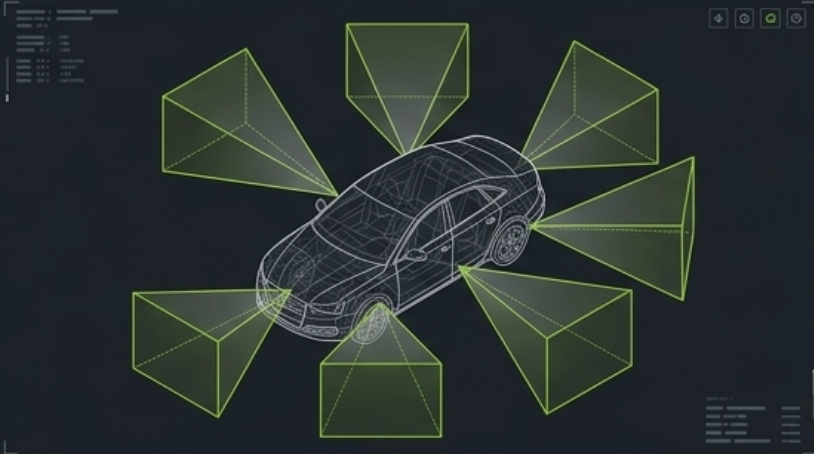
Autonomous driving requires simulating the world from multiple synchronised camera viewpoints — front, left, right, rear, etc. Each view must be geometrically consistent with the others.
The approach generates all 7 views in a single forward pass by concatenating the latent representations of all views along the temporal dimension — repurposing the temporal axis for multi-view. Per-view learnt embeddings distinguish cameras, and 3D RoPE embeddings are constructed separately per view.
For controlled scenario generation, the model accepts world scenario maps — top-down 3D vector maps projected into each camera view, containing lane lines (with types: solid, dashed, double yellow), road boundaries, traffic lights with state, and dynamic 3D bounding boxes of vehicles and pedestrians. This is richer than a segmentation mask — it encodes the semantics of the driving scene.
The generated driving video is good enough that downstream perception models (lane detection, 3D object detection) perform comparably to their performance on real video — lane detection F1 on generated video matches real video exactly.
4. Action-Conditioned World Generation
The most direct WFM use case: given a current observation and a sequence of robot actions, predict what the world will look like after those actions are executed. This is robot “imagination” — simulate the outcome of a plan before committing to it.
The action is a 7-dimensional vector per frame: $(\Delta x, \Delta y, \Delta z, \Delta\theta_r, \Delta\theta_p, \Delta\theta_y, \text{GripperWidth})$ — relative gripper displacement, rotation, and width.
An interesting architectural finding: rather than injecting actions via cross-attention or channel concatenation, the action embedding is added to the timestep embedding in the DiT’s AdaLN modules. The action modulates the denoising process the same way the noise level does.
| Injection Method | PSNR | FVD |
|---|---|---|
| Timestep embedding | 24.95 | 146 |
| Cross-attention | 24.41 | 159 |
| Channel concatenation | 23.11 | 267 |
Adding actions to the timestep embedding significantly outperforms alternatives. This makes intuitive sense — the action should modulate how the model denoises (what future to generate), not just what it attends to.
Key Takeaways
- Sim2Real via ControlNet-style conditioning translates structural inputs (edges, depth, segmentation, blur) into photorealistic video.
- Robot policy augmentation is the headline result: 100 real demos + 500 synthetic variants → 24/30 on out-of-distribution scenarios vs 1/30 unaugmented. This directly addresses the data scarcity bottleneck.
- Multi-view driving simulation generates geometrically consistent 7-camera video from HD map inputs, useful enough for training and validating perception models.
- Action-conditioned generation enables robot “imagination.” The key architectural insight: inject actions via the timestep embedding, not cross-attention.
- The common thread: a general pre-trained WFM + domain-specific post-training + the right conditioning mechanism = useful downstream tools for Physical AI.